
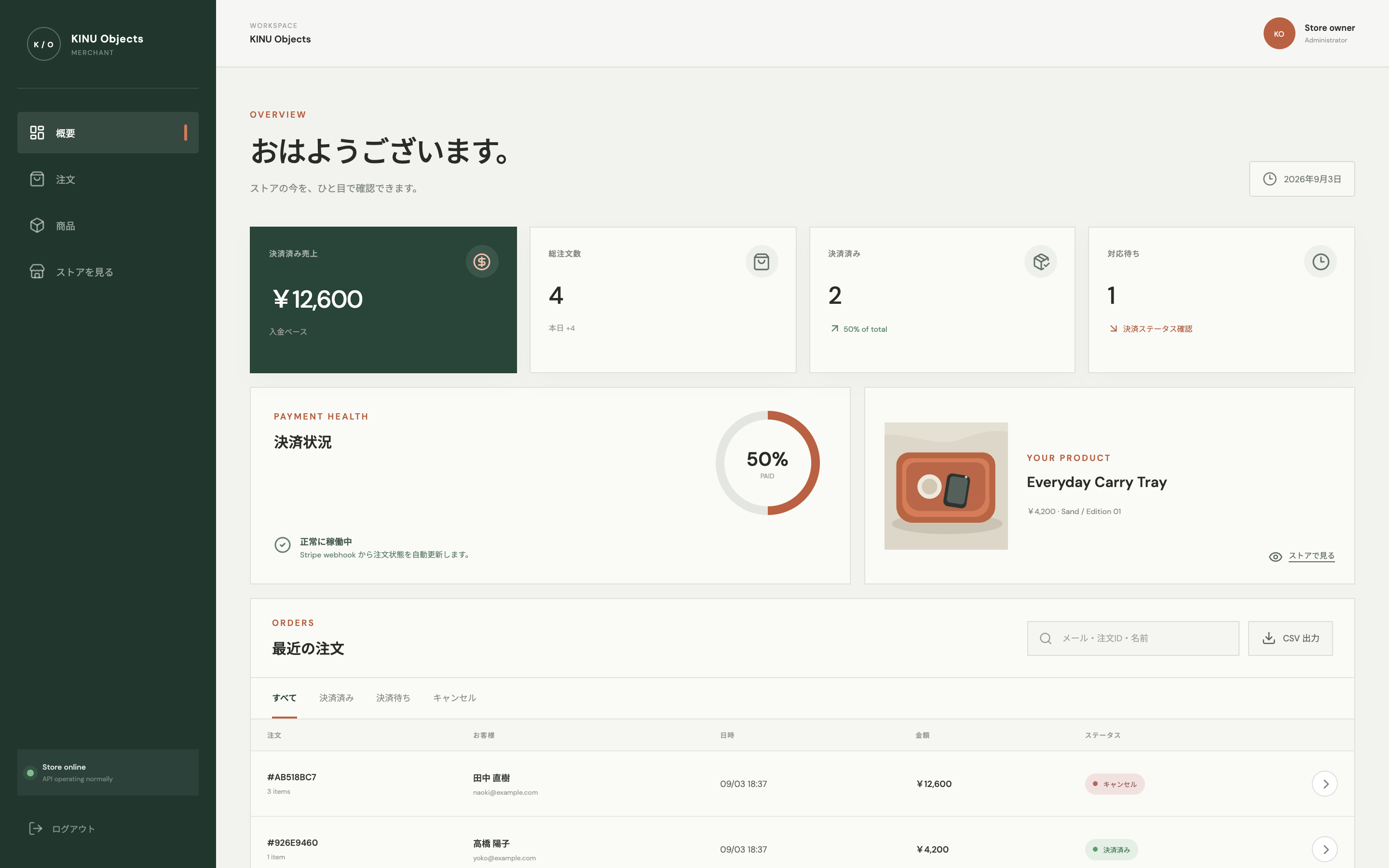
Independent commerce in Japan deserves a new era. MIIMOO has released Nano Checkout under the Apache License 2.0: a headless checkout base designed to leave room for your own store. Our ambition is to combine open commerce infrastructure with AI-assisted creation, giving merchants more freedom to build a business on their own terms.
A commerce base, shaped with AI.
A commerce base and a storefront do not have to be the same thing. The included React storefront is one reference implementation. You can work with AI to create a different interface for your brand and connect it to the same order API. That separation also lets developers design their own entry points for the web, LINE mini apps, or native apps.
The foundation includes product, order, and shipment management. It is built for Japanese yen, Japanese prefecture address forms, and a page template for disclosures under Japan’s Specified Commercial Transactions Act. Payments use Stripe Hosted Checkout. It is a focused starting point for small businesses that want to shape a distinctive purchase experience.
Every sale builds your own business.
The source of truth for orders lives in the Postgres database you choose. Merchants control their deployment, access permissions, and backup arrangements, and can export order lists as CSV. As sales accumulate, the information needed to understand the business should remain usable by the people building it. The architecture gives them choices over how that information is operated.
From creation to everyday operations.
AI can also support daily operations. An optional MCP endpoint exposes 11 tools for reading store, product, sales, and order information, changing prices and stock, and recording shipments through a compatible client. Buyer information is masked by default. Sending a full delivery address to an AI requires an explicit setting, making that access a conscious operational decision.
Shopify says that, when Network Intelligence is enabled, it combines customer data across stores to improve features; merchants can disable it, and customer data is not directly shared with other merchants. Nano Checkout offers a different operational choice: selecting and running the foundation itself. Necessary information still goes to payment and external AI providers, so understanding those connections and permissions remains part of running the store.
Open code. More room for independent brands.
Apache 2.0 allows commercial use, modification, and redistribution under its terms. The code can be inspected and adapted as the business develops. Today, Nano Checkout is deliberately focused on Japanese yen, one product per order, and one-time payments. We see this small, open foundation, combined with AI, as a way to give Japan’s independent brands more room to express themselves and grow.